
The building and how it is managed
In Latvia a flat is almost always in an apartment building that its owners manage together. All the owners form the owners' community, which usually hands management to a building manager (pārvaldnieks) or sets up an apartment owners' association (DzĪB). So your future costs and risks depend as much on the building as on the flat itself.
Much of Latvia's housing is in Soviet-era standard series: "Khrushchyovkas", the 103, 119, 467 and 602 series and the "Lithuanian project". Many of them face roof, façade, utility or heating renewal, and sooner or later it reaches your wallet. Find out whether the building has already been renovated or whether renovation is planned.
The key information is in the building file (mājas lieta), which the manager keeps electronically in the Construction Information System (BIS): owners' decisions, the management contract, income and expense reports, the reserve-fund balance and inspection data. Owners can view the file, so ask the seller to show it to you. Once a year the manager must give the owners a work plan and a report that also states the owners' total debts.
Ask the manager or the seller
- 1Who manages the building (a manager or an owners' association), and how big is the management fee per m²?
- 2How much is in the reserve fund, and how much does each owner pay into it a month?
- 3What major works have been done, and what is planned in the next few years (roof, risers, heat substation, façade, renovation)?
- 4Does the building have a loan, for example for renovation, and what does it cost per flat?
- 5How much do the owners owe the building, and does the flat itself have unpaid bills?
costly surpriseBefore earnest money: a statement of debts
Since 2026 the seller's unpaid management, utility and reserve-fund charges up to three years back pass to the buyer, and they do not show in the Land Register. Ask the seller for the manager's statement and write into the contract how the debts are settled.
BIS ↗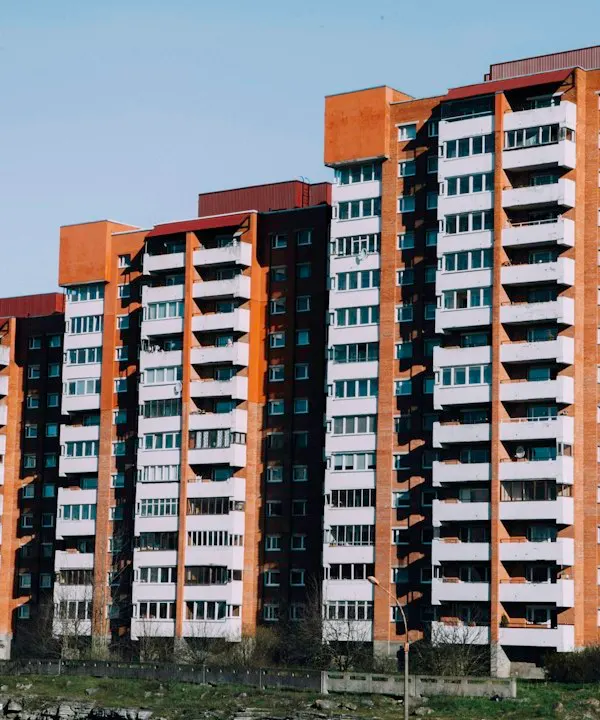
The flat itself
View the flat calmly and in daylight, not just in photos. Damp or mould stains (especially in the bathroom, under the windows and in outer corners), an odd smell, sloping floors or cracks in load-bearing walls can point to hidden and costly problems.
Note the age of the windows, radiators, wiring (is there a modern fuse box with circuit breakers?) and pipes: replacing them costs thousands of euros. Judge the layout, noise and natural light at different times of day too. If walls have been moved or rooms joined, ask whether the alteration was approved by the building authority and registered in the cadastre.
Damp and mould
The bathroom, under the windows and outer corners. A musty smell is a sign too.
Floors and walls
A sloping floor or cracks in a load-bearing wall may point to a hidden problem.
Windows and radiators
Age and condition: replacing them is expensive work.
Wiring and pipes
Does the fuse box have circuit breakers? How old are the pipes?
Layout and light
See the flat in daylight and listen to how much noise comes through.
Papers: Land Register, statement of debts, energy certificate
Check in the Land Register who the owner is and whether the flat carries a mortgage, prohibitions or other encumbrances. If there is a mortgage, agree in the contract that the seller's loan is repaid from the purchase price, and keep the money in a notary deposit or a bank escrow account until the entry in your name.
Since 2026 the buyer is liable for the previous owner's unpaid management, utility and reserve-fund charges and land-use fee that arose no earlier than three years before the purchase, together with late interest and penalties. This applies to voluntary sales after 31 December 2025 (Law on Residential Properties, Section 13.1), and these debts do not show in the Land Register. Ask the seller for the manager's statement of payments and write into the contract that the seller settles the debts or that they are deducted from the price. If you still have to pay, you can recover it from the seller unless the contract says otherwise.
When a flat is sold, an energy certificate is required if the flat is over 50 m² and has individual heat or energy metering; it is not needed if the whole building has a valid certificate. Most Soviet-era flats have no individual heat metering, so the building's certificate, if any, is what counts. A certificate is valid for 10 years, and once issued its energy figures must be shown in the listing. Certificates can be seen in the Construction Information System (BIS). For a home with energy class A+–C the bank may lend more.
Does the flat need an energy certificate?
Answer three questions (from the listing or the seller).
Individual heat or energy metering in the flat?
The land under the building: divided ownership
In many privatised buildings the land under the building belongs to someone else. This is called divided ownership, and the flat owners then pay the landowner a statutory land-use fee: currently 4% a year of the land's cadastral value, at least €50 a year, shared among the flats.
In December 2025 the Constitutional Court ruled that the current fee rules lose force on 1 January 2027. In October 2026 the government backed amendments setting at least 4% a year of the land's universal cadastral value plus reimbursement of the landowner's property tax on the land; as of November 2026 the Saeima had not finally adopted them. Since 2023 flat owners can also end forced divided ownership by buying out the land at its cadastral value, if owners of more than half of the flats decide so; the landowner's consent is not needed.
- 1
Check in the Land Register or on kadastrs.lv who owns the land under the building.
- 2
If someone else owns it, ask the manager how big the land-use fee is per flat and whether it has been paid.
- 3
Find out whether the owners have started buying out the land and what your share would be.
The neighbourhood and the future
When you buy a flat you also buy its location, and that can't be changed. Visit at different times of day and find out what is happening in the area.
Noise, parking, public transport and services (shop, school, kindergarten) within walking distance.
Planned construction or roadworks nearby: check the municipality's spatial plan.
The area's price trend and the most active real estate agents: see the market report and the area page.
Market reportPrices on the mapAgents in the area